
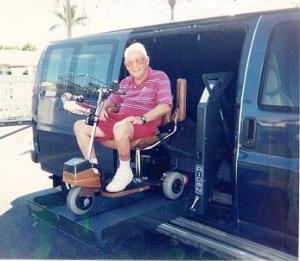
I was hiking Tuesday morning when my sister Mindy called to tell me Dad had passed on.
I’m still processing this. I’ve pored over his lifetime in photos, written three essays and I’m working on two obituaries. I phoned his home, and heard his voice on the answering machine. It was oddly comforting, like watching a classic movie or concert footage of a deceased performer.
I knew Dad’s time was near. I wanted him to check out before post-polio claimed his mobility and his dignity. I’ve forgiven him for not buying me a horse when we lived on a working farm. I will always be grateful that he was the definition of “resourceful.”
While I’ll miss him, I am so glad that he did not have to endure the worst of post-polio syndrome. His mind remained razor sharp to the end, but polio robbed him of mobility first when he was a teenager, and later just as he was about to embrace retirement.
My Dad’s mantra was “everything happens for the best.” Despite his positive focus, polio was a fact of his life. While polio presented specific choices and obstacles, it never defined Bill Fogelman, who saw opportunity in every situation.
He was outstanding in his field – really. I followed him down the row, putting a tiny pea seed into the earth where he poked a hole with his finger. I tried to step into his foot prints. My toddler mind could not yet grasp the miracle of the seed sending its roots earthward, its leaves skyward and its food to us.
Nor could I imagine that my Dad was also a miracle. At 84, he survived polio to live longer than anyone in his family ever had. Except for one skinny leg, a barely perceptible limp and slight osteoporosis – he had a normal, healthy body and a razor sharp brain.
When he was 15-years old, polio brought Dad to the hospital, then to rehab in West Haverstraw, NY and his first exposure to farming. He’d only known the urban landscape of Brooklyn before that. Polio also make him one of the few men free to attend college during World War II. Uncle Sam did not want his flawed body.
He graduated valedictorian from SUNY Farmingdale. He could have gone on to become a veterinarian or a meteorologist, but his passion was farming. For twelve years Windy Hill Farm on Long Hill Road in Guilford, CT sold the eggs produced by 5000 chickens, harvested the produce from a one-acre garden and ultimately became the site for solar homes.
My parents not only built the first solar home in Guilford, they convinced the families who purchased our land to build solar houses, too. My parents had a brief time to enjoy their accomplishments before polio intruded into Dad’s life once again.
To this day, no one knows why polio infected some people and not others. No one knows why some polio survivors get post-polio syndrome and some do not. For some people, polio was deadly, others did not even realize they’d had polio, recovering from flu-like symptoms in a matter of days.
Whatever polio did to his body, it did not compromise his brain. While we were growing up, Dad was an active participant in the civic life of his town, including service on the parks and recreation commission. That’s where I learned about the importance of attending town board meetings, voting in every election and participating in the life of our community.
By the time my parents moved to Florida, where a flat landscape and a heated swimming pool made it easier for Dad to move, he also brought a lifetime of negotiating experience, serving as president of the Post Polio Support of West Palm Beach, as an active member of his homeowners’ association and as event coordinator of his men’s club.
While he could walk, he combined travel and education as an Elderhostel student, and when he was wheelchair bound, he took classes at the community college.
He had the ability to attract angels – good friends who were there for him, making it possible to live in his own home with just a brief hospice stay.
So, even after he could no longer literally stand, Bill Fogelman continued to be outstanding to the very end.
Rest in peace, Bill, you earned it.
- Companies
- Caregivers
- Families

